Climate change: why the Guardian is using a new storyline to detail the threat

Big food consolidates under Organic & commodity squeeze

Drought-stricken California has only one year of water left!

Ogallala Aquifer’s dramatic drying sows deep concerns for agriculture

 – – – – 

The Ogallala Aquifer across the region has dropped about 325 billion gallons every year for at least the past four decades. To put that number into perspective, the roughly 1-foot annual drop in the aquifer is more than enough to supply all of Lubbock’s municipal water needs for 25 years.

And it has dropped about that amount every year since 1969, according to High Plains Underground Water District data analyzed by the Lubbock Avalanche-Journal, which is owned by Morris Communications, the parent company for The Topeka Capital-Journal.

In all, across the district’s 16 counties, the aquifer has fallen about 40 feet, a decline of roughly 44.9 million acre-feet since 1969.

Primarily used for irrigation, the aquifer is critical to the region where agriculture represents about 30 percent of the economy. Agriculture’s direct economic impact for the High Plains is upward of $3 billion annually.

As vast as the High Plains aquifer is — it spans eight states and holds nearly 3 billion acre-feet of water — it could still run dry. A Kansas study last year estimated it could in less than 50 years. It likely will be sooner here.

OGALLALA STORAGE

■ The Ogallala Aquifer holds nearly 3 billion acre-feet of water.
■ That water isn’t distributed evenly, and the aquifer doesn’t recharge the same everywhere. The stretches in Nebraska, for example, recharge with rainfall the most quickly.
■ Overall, the Ogallala has had about an 8 percent decline over the past six decades. In Texas, the Ogallala has dropped 150 million acre-feet during that time, accounting for roughly 60 percent of the overall decline.
■ From 2009 to 2011, the water table in Texas alone dropped 4.5 million acre-feet while it dropped 2.8 million over eight states.
What the U.S. Geological Survey estimates the Ogallala has in storage
■ Predevelopment in the 1950s — 3.20 billion acre-feet
   1980 – 3.25 billion acre-feet
   2000 – 2.98 billion acre-feet
   2010 – 2.96 billion acre-feet

“When anybody tells me it’s going to last for 50 years, I just laugh,” said Lucia Barbato, associate director at the Center for Geospatial Technology at Texas Tech. “How long the aquifer lasts depends on where you are.”

Across the district, the aquifer already has dropped below the minimum depth for large-scale irrigation in portions of six counties, including Lubbock. Four other counties have fewer than 15 years before running out of groundwater, according to the center’s projections.

“Certainly, the magnitude of the decline is greatest in Texas,” said Virginia “Ginny” McGuire, a hydrologist with the U.S. Geological Survey in Nebraska. “You’re still using water at a much faster rate than it’s being recharged.”

Rapidly declining

That nearly 45 million-acre-foot decline in the Ogallala Aquifer equates to about 14.6 trillion gallons of water over 45 years.

That is enough — if the average American uses, conservatively, about 69 gallons a day — to meet the Lone Star State’s entire municipal water needs for roughly 20 years.

An acre-foot of water is used to describe large water resources such as river flows and reservoirs. It is the equivalent of 1 acre of surface area covered by water 1 foot deep — 325,853 gallons. The aquifer decline is larger than Lake Mead, which filled to capacity is roughly 28.9 million acre-feet. Lake Mead is the man-made reservoir in Nevada that supplies Las Vegas.

As staggering as the decline is, what is actually used to irrigate roughly 1.7 million acres of farmland throughout the district is likely much more.

No one knows with certainty how much water has been mined from the Ogallala. Most agree, though, that groundwater irrigation has been extensive, particularly in the Texas High Plains.

The reason for the ambiguity is complicated. Part of the answer is in what is actually being measured — how much is in irrigation wells. The High Plains district isn’t yet measuring how much water is taken out of the Ogallala.

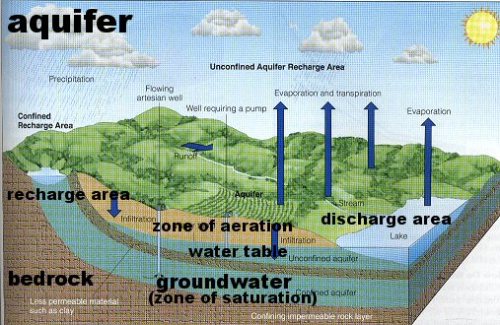
This distinction is important because of the second reason for the uncertainty. The Ogallala Aquifer moves — albeit slowly — about a foot a day from west to east, according to the U.S. Geological Survey.

That means the district’s annual measurements could be the Ogallala settling and not a true level change but rather a redistribution of the water in the aquifer to areas that are being pumped.

In short, more water is used than is being measured, experts say.

“We just think there’s been more water pumped than they show as a decline,” said Bob Stewart, director of Dryland Agriculture Institute at West Texas A&M University in Canyon. “I actually think that there’s more water in the aquifer remaining than a lot of people say there is. The bad news is, we’re using it faster than we say we are.”

image

‘Not sustainable’

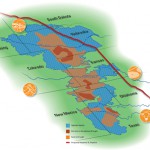
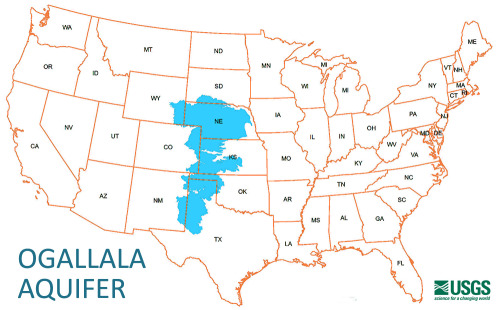
The Ogallala Aquifer is among the largest aquifers.  It extends 174,000 square miles beneath portions of eight states from South Dakota to Texas in one of the most productive agricultural regions in the world. Growing concern over extensive irrigation has led to, among other things, a state-mandated regional approach to conservation that requires planners to craft strategies that include a desired future condition.

The goal for Lubbock and the region is 50 percent left in 50 years.  The board recently drafted rules that would require producers to track and limit their use to help meet the district’s 50-50 goal and stave off possible further regulation from Austin, if nothing were done.

The district held public hearings July 29 in Levelland and Aug. 5 in Canyon. A vote on the proposed rule change could come as early as this week. No one can say how much of a difference this will make.

“They will have no trouble meeting the 50-50 because as wells go off line the aquifer will rise, but that’s not because the aquifer is recharging,” said Robert DeOtte Jr., civil and environmental engineering professor at West Texas A&M University. “It won’t be a real 50-50. It’ll be an apparent 50-50.”

Maps projecting depletion rates in the district by the Center for Geospatial Technology at Texas Tech estimate large swaths of Parmer, Castro, Lamb and Hale counties have fewer than 15 years of usable life left.

The region was built on agriculture. Irrigation made it more profitable. “What most people in this city don’t understand is their livelihood is connected to agriculture,” said Darren Hudson, director of Cotton Economics Research Institute at Tech.

Economic researchers at the institute estimate a third of the ag revenue would be lost with a return to dryland farming, which typically has lower yields.

“We should care that it’s dropping,” Hudson said. “It’s an important resource that we need to figure out how to hang on to it as long as we can. We want to get the most that we can out of it and make it last as long as we can because the regional economy is so dependent on this resource and what we produce from it.”

Less than 30 percent of the cropland overlying the aquifer is irrigated. But more than half of the counties where depletion is a threat to irrigated agriculture are in Texas, according to a 2012 Texas Tech report on the future of the Great Plains.

And of those 19 Texas counties, nine are within the High Plains Underground Water District. The counties where depletion could mean the end of irrigated agriculture have also had some of the greatest water-level declines in the past four decades.

Curtis Griffith, a third-generation farmer who leases farmland in Cochran and Terry counties that has been in his family since his grandfather migrated here in the 1920s, has seen the pumping capacity decline by 90 percent.

Wells that once produced 500 gallons per minute now give up 50 gallons per minute. The way Griffith sees it, the land and the water beneath it aren’t just his.

“I just feel like I’ve still got some responsibility to future generations to pass the land on in as good a shape as I can,” Griffith said.

The counties where irrigated agriculture is threatened are Bailey, Castro, Cochran, Hale, Hockley, Lamb, Lubbock, Lynn and Parmer.

“We know it’s a limited supply and we just have to manage it as best we possibly can,” said Steve Verett, executive vice president of Plains Cotton Growers. “Farming is not going to go away. It’s just going to be different.”

Urgent Need to Calculate Costs of Soil Erosion

VIDEO: 5 min of food fun with Jon Stewart – ‘Screw your health study’

 – – – –

By this point, we all know that most people eat things that are terrible for them on a regular basis.

Americans consume an estimated 500 more calories per day (the equivalent of a McDonald’s Big Mac) than they did in 1970, according to the United States Department of Agriculture.

But it’s not all our fault: Americans get help in their bad eating habits from the companies that rely on those habits for profit, Jon Stewart argued in a segment on Tuesday’s The Daily Show.

Stewart targeted “Big Agra and the food lobby” for feeding us what he called an “addictive, fattening, death menu of artificial chemicals, antibiotics, and cool ranch carcinogens,” and ridiculed the ways companies are responding to Americans’ increased dietary awareness.

“Screw your health study”

Rather than back off in the face of health concerns, some companies are doubling down.  Stewart highlighted a new deep dish pizza wrapped in three and a half feet of bacon from Little Caesar’s, plus advertisements for “endless” buffets and appetizers and Olive Garden’s “buy one, take one” entree special.  

He called this the “I don’t give a f*** approach,” by which fast food companies essentially say “screw your health study.”

Next, Stewart ridiculed “the making-food-slightly-less-bad-for-you craze.”

In this category, we see McDonald’s announcing plans to phase out chicken raised with antibiotics from its menu — “I’ll miss treating my ear infections with the buffalo ranch chicken,” Stewart jokes — and Dunkin’ Donuts planning to eliminate titanium dioxide from its powdered donuts. (The chemical, which makes food and also things like toothpaste appear bright white, is classified as safe by the FDA.)

Needless to say, however, chicken nuggets and donuts still don’t qualify as healthy food. Stewart reaches maximum scorn levels when he addresses companies that don’t actually change their products at all, but pretend to be better through crafty PR.

His case in point is Kraft, which got the Academy of Nutrition and Dietetics’ “Kids Eat Right” label on its Kraft Singles after donating to the Academy to support the program. (To be fair, the label says in small type “supporter of” Kids Eat Right — not “approved by.”) Kraft Singles are labeled “pasteurized cheese product,” not even real cheese.

“It turns out the Academy of Nutrition and Dietetics is an academy in the same way this [Kraft Singles] is cheese,” Stewart quipped.

Doctors Fight to Ban Fast Food From Hospitals – Good Reason.

 – – – – 

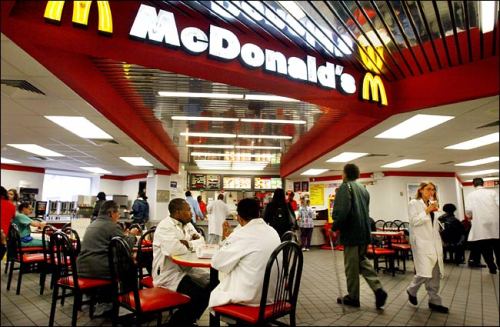
McDonald’s always seems to have its logo plastered where it doesn’t belong. Every four years, for example, millions watch in disgust as elite athletes smile into a camera, take a bite of a Big Mac, and swear their undying allegiance to the McFlag—all because the multibillion-dollar corporation shelled out a small fraction of its massive profits to become “The Official Restaurant of the Olympic Games.”

But while those high-profile ads are stealing the spotlight, the corporation has a more out-of-place, under-the-radar partnership: McDonald’s currently has contracts to serve food in 18 hospitals across the United States. The quick-serve mega chain doesn’t just serve burgers to guests in cafeterias—it also delivers meals right to sick patients’ beds, hosts birthday parties, and offers a snack menu with nachos and ice cream.

The medical profession is fighting back:

Cardiologist Aseem Malhotra of the Royal Free Hospital in London criticized these controversial marketing tactics in a June 2013 article published in the British Medical Journal. “The junk food industry’s aggressive and irresponsible marketing has even been allowed to hijack the very institutions that are supposed to set an example: our hospitals,” he wrote.

That view is echoed by the Physicians Committee for Responsible Medicine, a nonprofit organization based in Washington, D.C., that promotes preventive medicine and alternatives to animal research, and encourages what it describes as “higher standards of ethics and effectiveness in research.”

The committee has been doing a series of hospital food reports to analyze just how dire the situation is. In their fifth and most recently published installment, experts surveyed more than 200 hospitals around the nation and discovered McDonald’s isn’t the only offender: Chick-Fil-A is in 20 hospitals, and Wendy’s is in five. Most of the hospitals are located in the South, where, according to Centers for Disease Control statistics, obesity rates are disproportionately high.

It’s one thing for the restaurants to be inside the hospitals, but it’s another for their finances to be inextricably linked. The committee analyzed five different contracts and found that the hospitals are actually incentivized to help the fast-food restaurants sell more processed junk food.

In one example, the McDonald’s inside Ben Taub General Hospital in Houston “can terminate its lease if yearly gross sales of Big Macs and other junk foods do not reach $1 million,” the committee’s report states. “Moreover, the monthly rent McDonald’s pays to the hospital increases based on food sales.”

For every Big Mac sold and for every McNugget dunked in corn syrup-y barbecue sauce, the hospital drops another dollar in its theoretical pockets.

image

But, as the report states, there is hope, and conditions have been improving. Since the committee started issuing its food reports, two hospitals mentioned have removed the junk food: McDonald’s closed at Riley Hospital for Children at Indiana University Health, and St. Louis Children’s Hospital no longer carries Dairy Queen products. Several other fast-food restaurants have also recently closed in hospitals around the country.

The committee also mentions that more and more hospitals have been adding fresh fruits and vegetables to their cafeterias. But PCRM’s president, Neal Barnard, wants to take it one step further: “Just as cigarettes are banned from hospitals, why not do the same for meat, cheese, and other junk foods?”

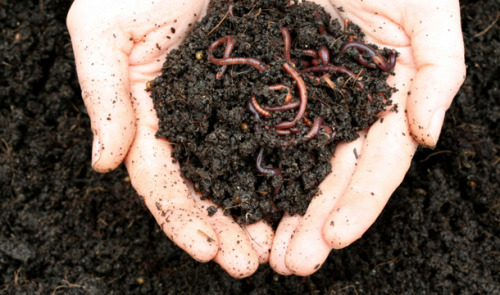
REPORT:  earthworm vermicompost can replace destructive chemical fertilizers

Don’t Be Fooled: Cheap Fast Food Still Isn’t Healthy

2015 Dietary Guidelines; will it crumble under infrastructure pressure?

 – – – –

curator:  Some may find many of the ‘15 guidelines a bit comical (of course eggs and less sugar are good for you), others are concerned that these latest recommendations perpetuate the falsehood that all food is treated/created equal and sourcing matters less than food group or category (i.e grass-fed meat).  When I say some people, and others – I of course am included in those buckets… But, these are steps in the right direction and positive discussions to begin change that will eventually be defined by consumer awareness. 

6 Highlights of the 2015 guidelines:

1. You can eat eggs. And shrimp. – fast curator fact – the closer you are to the origin of life (i.e. eggs, sprouted grains, proteins) the healthier the outcome for higher trophic levels.  For years, we’ve been told to be mindful of—and limit—how much cholesterol we get from our food. That meant items like eggs and shrimp felt taboo. The logic went like this: dietary cholesterol would raise blood cholesterol. Turns out there isn’t enough science to support that line of thinking.

2. Steer clear of too much sugar. This might not be news to you. And, in fact, we’ve written about the harms of eating too much added sugar here andhere. So it’s just awesome that our national diet advice is following suit and warning all Americans to limit their added sugar intake.

3. Cut out refined carbs. Also known as white carbs. This too might not be groundbreaking to you. The health benefits of whole grains are well documented. So let’s give the Dietary Guidelines Advisory Committee (DGAC) a pat on the back for identifying refined grains as “detrimental” to our health.

4. One diet doesn’t fit all. This is my favorite takeaway. To lower your risk of heart disease and of becoming overweight or obese, the draft guidelines don’t point us to one narrow diet or a combination of single nutrients. Instead they encourage a general healthy diet pattern. How you achieve this diet is up to you!

5. Consider the environmental impact of foods. Critics have attacked the DGAC’s move on this one, saying they are nutrition experts, not environmental experts. And while that criticism is fair, you cannot separate the topics of what to eat for your health and what to eat for the health of the planet. They need to be considered in conjunction. It’s refreshing to see the advisory committee take this on and encourage Americans to eat more plant-based foods as well as provide guidance on seafood choices, among other suggestions.

6. Pump up the produce! That’s right, we still need to eat more fruits and vegetables. And the draft Dietary Guidelines are really hitting that message hard. But here’s the good news: adding more produce to your diet makes it pretty likely that you’ll be getting key nutrients—like vitamins A and C, folate, magnesium, fiber and potassium—that the guidelines say most Americans fall short on.


image

more…   What should we eat to be healthy? That’s an important question, because, according to the recently releasedScientific Report of the 2015 Dietary Guidelines Advisory Committee, what we eat has a lot to do with how healthy we are. It’s as simple as that.

But on a national level, it becomes more challenging, especially when considering what the report refers to as the “two fundamental realities” that need to be kept in mind. 

The first is that about half of all American adults — 

117 million individuals — have one or more preventable, chronic diseases, and that about two-thirds of U.S. adults — nearly 155 million individuals — are overweight or obese.

No question about it, those are daunting numbers.  The report points out that these unhealthy conditions have been “highly prevalent” for more than 20 years. Also, according to the report, eating unhealthy foods and consuming too many calories, coupled with too little physical activity, directly contributes to these preventable health problems.

The second “fundamental reality” is people can improve their health —

By making changes in their lives, among them eating healthier foods and getting more physical exercise.

In other words, for the most part, we, the consumers, are in the driver’s seat, and the dietary guidelines are there to serve as a road map. It’s all about helping to prevent a culinary crash that could ruin our health  — or kill us.

And, yes, food safety is part of this, especially when considering the Food Safety Modernization Act (FSMA), which, like the report, takes a preventive approach to safeguarding people’s health.

As for the role consumers play in food safety, a section of the report states that individual behaviors, along with sound government policies and responsible private-sector practices, are needed to reduce foodborne illnesses.

A quick background

The 2015 Dietary Guidelines Advisory Committee was jointly established by the secretaries of the US. Department of Health and Human Services and the U.S. Department of Agriculture. The committee was asked to examine the Dietary Guidelines for Americans, 2010, to see if there is new scientific evidence that can be used in the 2015 Dietary Guidelines.

The primary focus of these ongoing reports is to develop food-based recommendations for Americans 2 years old and older. Instead of being mere “dust collectors” to be put on a shelf and forgotten, the reports are used to help develop federal nutrition policy and a variety of programs, among them education, outreach, and food-assistance programs throughout the nation, including food stamps.

What we already know, or at least believe

For the most part, the evidence the committee examined reveals what many people already know, or at least believe to be true: A healthy diet is higher in vegetables, fruits, whole grains, low- or non-fat dairy, seafood, poultry, legumes and nuts; lower in red and processed meat; and low in sugar-sweetened foods and drinks and refined grains (such as those used in cookies, snack crackers, cakes, and most breads).

But the report also shows “moderate to strong evidence” that higher intake of red and processed meats was identified as detrimental compared to lower intake, as is the case for higher consumption of sugar-sweetened foods and beverages, as well as refined grains. That’s where some of the nation’s favorite foods — burgers, pizza, tacos, sandwiches, mixed dishes, desserts and sugar-sweetened beverages, all of which are mentioned in the report — come into the picture.

The report suggests that the composition of many of these food items could be improved in ways to increase consumption of vegetables, whole grains and other under-consumed food groups as well as to lower intake of sodium, saturated fat, added sugar, and refined grains. The report also noted that no matter where people are buying their food — whether in supermarkets, convenience stores, schools, or at the workplace — overall, the needs of a healthy diet for the U.S. population do not meet recommendations for vegetables, fruit, dairy or whole grains and exceed recommended amounts of sodium, saturated fat, refined grains, solid fats and added sugars.

Reading between the lines: The typical American diet is fraught with health risks.