As the basis of preventative healthcare, we’ve lost our way in sourcing food for its nutriment at the cost of price alone. Proving increasingly taxing on body and land, an allegiance to the cheap food of modern agriculture has mainlined a steroid-era of commoditized foodstuff built on misguided information, immature science and a lack of transparency to the global mainstream. Now, so widespread throughout the Western diet & world is cheap food, most consumers have a compromised appreciation of food values without knowledge of correlated risk or potential adverse effect.
The empirical evidence of our ill society is proving that an overfed and undernourished people is costly with upkeep. With the lowest percentage of discretionary income allocated to food in the developed world, Americans now spend less money on what sustains us while allocating more than ever before on reactionary healthcare. We must assess the validity of placing our entire nutritional security over the long-haul on a single approach of fundamentally unproven agricultural practice. Proven depleting and expensive with waste, the longevity of current conventional food production in the United States, and now abroad, will continue to prove more challenged.
Furthermore, propagating the only failed diet in the history of mankind for the short-term monetary benefit of distributing cheap food, atwhatcost will be incurred before the Western diet is recognized for its role as culprit of misgiving and instigator of modern plagues found in form of chronic illness, obesity and habitual poor eating habits? Teeming with the uncalculated cost of externalities to human & planetary health, the basis of our food system so dependent on price over value is a false economy in dire need of reflection.
In the last half century, we’ve seen incredible advancements in human care & life sciences. What’s most peculiar, or potentially premise for these forced advancements in responsive care, the process we use to craft our nutrient security has not progressed. In fact, the opposite has proven true. The cheaper we make the volumes of food servicing the expanding Western diet, the more of these modern plagues and food safety risks we incur. Simply, we need a paradoxical change in remedying what ails us. That stems from the notion that it’s not caloric; it’s about sustenance – and when we all understand this simple rule, sourcing becomes the fix to many of the problems in the food system, and greater well-being of body and planet result from food production insight.
Aside just remediating production integrity concerns, there’s incredible opportunity to build innovation economies that institute efficiency to a current arcane food system. With dead loss on perishables and food waste now topping 40% of all foodstuff that reaches the supply chain – sourcing foodstuff is ripe with potential advancement. Furthermore, our linear perspective of agriculture that currently does not take into account the many environmental externalities directly associated to food production is quickly becoming one of the largest contributors to climate change, biodiversity loss, and water contamination. When we evaluate the whole picture, our food is not cheap at all, but instead very expensive with diverse economic loses. The remedy to heal exponentially growing human, planetary and economic expense comes by returning focus to best sourcing practice and further connecting consumer awareness to the food they eat. This type of beneficial public and private initiative in and of itself is prepared for financial innovation. more…
As a shrinking World teeters on the cusp of political and environmental instability, impossible is it now for anyone to consider a planet of boundless growth. Earth will remain a finite resource of no unclaimed terra, nor further exploration into a great unknown. Equally important to this realization is the fact that there’s no far reaching “never-never” land to continue to exploit nor buffer the impact of our exploding waste stream.
Effectively, since empowered to enact freewill on our surrounding, and the correlated adoption of hubris in believing we have control of the systems that contain us – mankind has been a terrible shepherd. It’s becoming evidently clear to those in susceptible areas who’ve been forced to pay attention, and soon for all of us sharing the same interconnected environment, we must do better living within the rules set forth by regenerative systems. If we do not heed the warnings and act proactively, we’ll fall victim to a required recognition that depleting finite resources of planetary boundaries will be expensive in recovery.
For the most fundamental human needs of food & water – the additional costs of mining sea & soil without replenishing systems needed for self-sustaining nutrient cycling in all trophic levels has created a perpetual and non regenerative waste-stream. With no scope nor expectation of repayment of these taxes, we’ve externalized the “true costs” of cheap food & water that will incrementally lessen the vitality of the whole system the longer we maintain an addiction.
Truth is, by not accounting for the true costs of externalities in the staples we’ve grown accustom – food, water & energy – we’re bending the resilience of the ecological & planetary boundaries keeping the whole system afloat. As a universal truth in rectifying these impacts – consumers must become more immersed in the facts. With greatest potential to be most intimate to us all, the provenance of food is a most logical place to begin. The affect of what actually reaches your dinner table is far greater than just the resulting personal gain or satisfaction. Modern production does not account for waste, environmental impact nor ecological footprint – that’s our actuality, but not accountability! We’ve flattened a circular process into a frozen rope, and our abundance of natural resources had yet to force concern. But, increasingly costly with health, wellbeing, stability and monetary expense the longer we wait – we’ll soon be forced to embrace change.
Most in the know will tell you that water will be the conduit of change. Either dealing with sea level rise & storm damage flooding; or a lack of rain in conjunction groundwater exhaustion where deep water aquifer tapping should have us gravely concerned. The potential monetary expense of sea damage in big coastal cities; or loss of stable food security from production mainstays like California and our mid-western breadbasket so reliant on an unsustainable practice of gulping the Ogallala – water (sea & fresh) will drive change quickest. Haunting is the realization of flooded East coast cities or a sequel to the Dust Bowl effecting most susceptible areas with the greatest impact on population densities. more…
Underpinning man’s ability to do more than survive, but grow, learn and thrive – our most profound genius of community, society and culture are directly correlated to an ability to source sustenance to growing populations. Now, overfed yet increasingly hungry & malnourished, the past 25 years have forced consumers of the Western diet fatter, chronically more ill, and disconnected enough to their food-system that most have lost perspective to the primary purpose of the food we eat. As the World teeters on the cusp of a Malthusian catastrophe unlike no other, for the first time in history to realize resources and unbridled growth are increasingly finite, more mouths turn to conventional practice for nourishment, and instead receive food-systems taxing to soil, body & environment rife with backlash.
The Savory Institute’s plan to remediate FOOD & CLIMATE CHANGE thrives with the soil
The key to mitigating climate change will be putting grasslands to work, and the conduit of success comes on the hoof of healthy pastoral livestock. So says world renowned animal husbandry expert and founder of the Holistic Management production model Allan Savory.
IT WORKS BASICALLY LIKE THIS:
A symbiotic relationship between all microbial living things has effectively resulted in a living sponge that surrounds the planet. Often referred to as the earth’s thin skin, this living soil is so more than that. It’s in fact the entire digestive tract for any and all living matter that has existed over the last billion years since bacteria and fungi started playing nicely together. A few hundred million years ago, those relationships began incorporating larger flora and fauna into the recipe, and through time a proper balance was struck amongst all shared ecosystems to cycle nutriment needed for every trophic level through the microbes teeming in soil. Basically, our health and that of our environment is uniquely connected to this living soil.
Just in the past few centuries we’ve unknowingly begun to tweak the process again. And, in the last 50 years – scale of this disruptive approach has begun catching-up with a stable environment and again changing a once thriving ecosystems for the worse. Today, as our growing footprint and modern agricultural practice has effectively lopped off a few key links in the chain throughout the world – the collective is proving incrementally detrimental to diversely connected biomes. Hard to believe that taking ruminants off pasture can disrupt our existence, but with the grand scale we’ve instituted change in such a short time – the unintended consequences to systems that take millions of years to balance will prove immensely disruptive unless we begin appreciating how to define broader solutions and not remedy of symptoms. Through Allan Savory we’re learning that when properly managed – the matter that constitutes the sponge of our soil can be reinstated back to an original purpose from which it evolved. A system of unparalleled storage capacity which provides a fix to a water & carbon issue spiralling out of control.
It’s based on a concept called nutrient cycling – a process similar but much broader to what happens in our own bodies. In fact, the breakdown of materials by microbial life in soil is not that far removed from what happens in your gut. By removing the waste stream of grazing animals and the results of the actions of their predators (equally an essential part of the puzzle) from once thriving grasslands we’ve systematically changed the nutrient cycling programs of most of the world’s great grasslands. From sub-saharan Africa, the Great Plains of North America, the Southwest of the US, many Northern parts of the Far east, and a good portion of Australia – we’ve disrupted the essential nutrient cycling and stopped the flow of recycled energy on a significant portion of ground cover around the world. Effectively, taking the animals who harvest, fertilize and aerate the soil has resulted in dormancy, compaction, loss of biodiversity on that land leading to a general lack of resilience especially when dealing with the impact of other natural elements like wind, storm, flood or drought.
(coined by Elaine Ingham, Soil Foodweb is the basis for nutrient cycling)
The organic matter and bugs in healthy topsoil hold 10X the volume of water as conventionally treated agricultural lands, never-mind dormant desert soils lacking thriving biology needed to maintain living plants that were once so important in feeding the pastoral animals. Collectively, and not unrelated – they no longer exist together. Removing animals, and categorical poor agricultural tilling & irrigation practice result in lesser ecological vigor in the once living soils of the global grasslands. This has resulted in epic topsoil runoff, loss of fresh water storage, excessive carbon release and a lack of sequestering capacity. A grand scale squeezing of the once massive grasslands sponge creates further dystopian scenarios for any of those animals that remain disconnected as a broken links in the chain. Representing 60% of the earth’s land cover, what we’re realizing is that grasslands are set to change all of our in-connected existence – including that of a stable environment for us all – unless we begin to give them their due. Furthermore, as slash and burn practices destroy much of the ecologically sensitive tropical forests and forest land, and more folks enter the fossil fuel burning lifestyle – we’re going to need a broader solution with fast acting results. The exciting part of Allan’s plan is the remediation to an unbalanced system is pretty straight-forward, and the unintended consequence leads to a cleaning a food system and improved human and animal health.
(transforming desertification through engaging working lands in Mexico)
All of that considered – the hypothesis of returning the highest trophic levels back to the ecosystem under proper guidance and practice in effort to jumpstart co-evolution and best recalibrate the system to once again thrive as it did before our meddling seems one of the most pragmatic plans we’ve got as it comes in tow with economic drivers correlated to evolving consumer demand for better quality foods. Simply, focused first on the single largest segment of food – animals – cleaning our food production models through pastoring hoofed ruminants and free-range fowl on grasslands and silvopasture (combined effort of forestry & grazing) we make significant strides in controlling our destiny through focus on Onehealth of animal, human, land & environment. Allan and his teams around the world are set on changing many misnomers by introducing large scale herds of animals, wild and food alike, back into systems where the collaboration will benefit the wellness of all living matter through a progressive plan of adaptive nutrient cycling from the Soil-to-Table.
(a side-by-side comparison of holistic practice in Aberdeen South Africa)
The supply chain disruption of plant ready nutrients is driving many of the grasslands around the world to a point of desertification. Allan, and now many others including myself, believe that integrating animals back into the equation begins a systemic evolution back – reinvigorating the nutrient cycling programs that will again give the living soil the ability to sequester the excessive amounts of carbon we’ve dumped into the environment over the past 100 years. This is more than just common sense, there’s a great deal of evidence supporting Allan’s immersive Holistic Management biomimicry plan that uses systems-based resource management focused on raising and rearing healthy animals back into natural environments as the crux of change. With thirty years under their belt, and tooled with analysis and empirical evidence from thousands of years of agricultural practice used prior to modern CAFOs (concentrated animal feedlot operations), the Holistic Management Institute, and since 2009 the Savory Institute with its expanding global hubs, have been working diligently to change producer awareness to the broad reaching value of a regenerative agricultural approach.
Today, as we the consumer have begun asking more questions relating to that of food’s value – more folks have begun speaking with their dollars. This increasingly makes us more savvy and concerned with compromises incurred with conventional production vs. that of circular agriculture’s focus on an integrated outcome of Onehealth to all living things in the food chain (including us) and the environment we share. To this, as more awareness and education come to bear – it seems prime opportunity for additional free-market influential companies (strategics) to jump on board in servicing growing consumer sentiment driving food as a pillar of human and planetary healthcare.
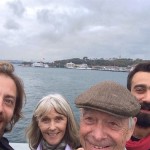
above: founders Volken (Left), Durukan (right) welcome Allan Savory & Jody Butterfield to Turkey
Prior to leaving for October’s Eisenhower fellowship program in Turkey – I reached out to Allan Savory for advice. I explained my intent and program objectives that correlate the value of better quality food to human and planetary healthcare. Supremely gracious, Allan invited me to their forthcoming global conference happening in San Francisco, which happened coincide with the same weekend I was leaving for Turkey. Equally exciting, he informed of work of Durukan Dudu – the head and co-founder of The Savory Institute Turkey Hub. Allan suggested I make time to visit Durukan and team on the Anatolian Grasslands during the research program in October. The Savory Institute has established disciples throughout the world through the launch of international hubs to promote, teach and evolve best holistic practice through returning animals to working lands. Allan has earmarked and invested in future leaders interested in progressing the previously described mindset, and I’ve come to learn that Durukan Dudu was one of these intelligent and passionate thought leaders evaluating anti-desertification methods in Biga Turkey. Immediately enthralled, my program managers and I integrated a visit into the fellowship.
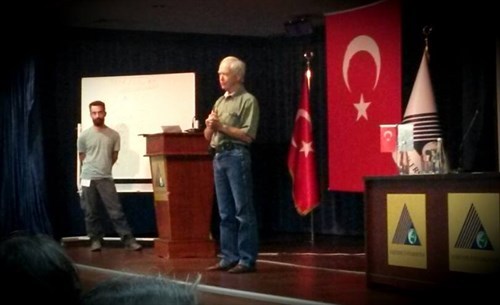
(Allan and Durukan presenting food & climate plans & findings in Istanbul)
Fitting a visit in between Durukan’s return from the Savory national conference in San Francisco, and my traversing of the Turkish countryside – we orchestrated a time to meet and tour the Savory Institute Turkish hub in the middle of the month. I must say, as I made the drive to Biga from Bursa I was very excited for this opportunity. Despite the Anatolian Grasslands Savory Institute research-hub being off the beaten path – it was in a pretty epic location near where the mouth of the Sea of Marmara meets the Aegean sea. Somewhat strangely, driving through the terrain near Biga reminded me not of other parts of arid Turkish topography I saw earlier in the Northeastern part of the country, nor a mediterranean landscape as I witnessed down by Izmir & Ephesus, but the rolling pastoral hills looked a bit like parts of upstate NY & Vermont. Stopping a few times to look out over the many trees separating farmlands, most noticeably the beautiful local Oaks that were interspersed in the evergreens throughout this scenic undulating countryside I began to wonder if I was grasping for something that just wasn’t there. I wasn’t homesick yet! I’d later make a few comments relating to what I saw, but I think my vision of some Northeastern roots was lost on this international troop deeply immersed in the task at hand – how returning animals to open pasture in Turkey will benefit diverse ecosystems and biodiversity throughout the world. Later, as I took a closer look at the soil tilth and makeup – I realized that despite the resilience of many of the same plants we share, the framework for which they thrive was so very different. Further proof of the power and complexity living soil represents.
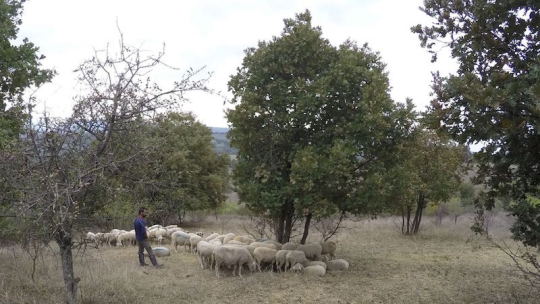
(Durukan & hardworking team of Anatolian watchdogs look over a portion of the flock)
Upon arriving at the research hub in Biga I was welcomed by Durukan and his co-founding partner and cousin Volkan Buyukgungor. We sat on their farmhouse porch at basin of their elevated pasture land and chatted for hours. It seemed we became immediate compatriots. People from halfway around the world aligning on many aspects and sharing a similar vision for the future. They explained all of the hard work they’ve put-in over the past few years cobbling together resources to continue to buy or rent more land while increasing the size of their flock. Turkey is going through an interesting period in agriculture. Unlike the States which has lost, but now finds rejuvenated interest in smaller scale farming, Turkey is in the middle of their own infrastructure discussion. In fact, earlier while in capital city of Ankara I learned from the Agricultural Ministry their growth plan to consolidate many of the small farms that employ 3 Million Turkish farmers through large scale acquisition, or if needed – forced eminent domain. In regions now gaining new water access through a large scale commitment to dams equally for hydro and irrigation purposes this is creating new socioeconomic and political issues. This will pan out with interesting results in the next few years especially in the Gap region in southern Turkey that borders much of Syria. Heavily inhabited by Kurds, this brewing tinderbox will have to be closely watched especially with the AK party’s re-election and track-record in flexing their muscles when something is deemed to benefit the State.
Biga is different than the Gap region, and despite the aesthetic of a Update New York landscape – it’s very different than the US. For that matter, so is most of the current farming infrastructure in Turkey. That said, our common ground is finding a happy medium in production scale, despite coming at it from completely opposite directions. The vast majority of Turkish farms are smaller farms, which actually continues to grow further splintered through succession plans of generations inheriting smaller and smaller parcels and further splitting working lands as each child gets a piece of the action. We like to claim that in the US 97% of farms are family owned, but when you break down total production volume – that statistic is mostly fluff as the vast majority of production in the US is from very large farms, often leased from an entity (I will follow with further essays delving deeper). In Turkey, total production volume and the number of small farms do correlate. As they try to figure out a new identity that will allow gross agricultural revenue to increase from current $50B to predicted $150B by 2023 – change seems inevitable despite domestic consumers not necessarily correlating to the Ministry’s plan to adopt a Western production model of producing volumes of cheaper food at the sacrifice of nourishment and employment.
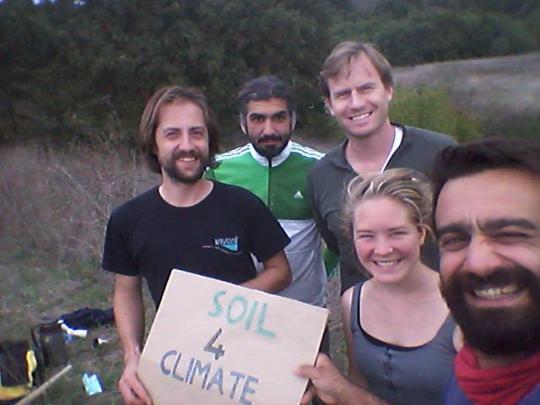
(I join Volkan, Durukan and team for a quick photo shoot on the grasslands)
After a wonderful lunch of all farm-grown produce, homemade cured meats and pomegranates (something you won’t find in Vermont) picked from the tree in the backyard – we headed up into the pasture to explore, see the flock and learn more. Visiting these animals is so important. A noble life indeed! The holistic relationship of the soil, plant and animal mentioned in Part 1– fixing the broken link in the chain by re-assimilating our ruminant friends back onto the farm is where this whole concept comes into play in Biga, and for every struggling grasslands across the world. Simply, the mutually beneficial ecological evolution of these trophic relationships have built a closed loop feeding cycle that equally supports and affords resilience to each part of the food system no matter how grand or small.
As detailed in the Soil Foodweb diagram presented in Part 1 of the Food & Climate essays – a mentor of mine, Elaine Ingham coined this concept that evaluates and bolsters how the relationship of billions of bugs colonizing healthy soil can work in unison to reform any type of waste stream into plant ready nutrients. That needed starter kit for a successful nutrient cycling program is most perfect when it comes delivered not from synthetic shots of energy from petrochemicals and refined minerals, but instead by feeding the soil with what it has evolved to draw nutrients from – animals. The constant moving and turning of those animals has also worked with natural selection just as we’ve witnessed with macro evolution to afford opportunity for only the strong and proficient to survive when dealing with their larger and now essential ruminant brethren. Effectively, the digestion recycling energy in the belly of cows is just the first step in providing needed energy to the health of living soil.
In and around Biga, where the smaller farms of often authentic practice remain the mainstay, some of Durukan and Volkan’s plans seem in line with generations past. But, as the allure and of the short-horizon gains of modern agriculture envelops their region – many of the farming methods they’ve implemented like no-till, and timed mob grazing – a practice that replicates having predators to keep grazing animals constantly moving appear old-school rather than revolutionary to other farmers in the region. Gaining continued interest on circular farms in the US, this process of mob and pulse grazing moves animals from paddock to paddock in a quick enough period to prevent the animals from destroying too much of the grass (an effort to have the animal eat no more than ½ of the blade during a feeding period, and surely none of the roots) before they are moved onto a next strategically earmarked parcel. Successful examples like the reintroduction of wolves in Yellowstone further prove that it’s about the entire food chain evolution along with grazing animals. The process works especially well with the economics of production agriculture as integrating diversity of species which often prefer different grasses, forbes and seed types on the same fields – can improve stocking densities and revenue stream diversification on regenerative lands. Durukan and Volkan have brought folks from all over Europe and the Middle East to learn from these practices on the Anatolian grasslands. What I find so intriguing, along with the science these guys are implementing to make this work in the field and in the soil, they return to the idea that their methods produce a better tasting product. Which in the long-run I believe makes this concept scalable and desirable to a consumer-base in Turkey, in the States and globally as more consumers return to the fundamental value of food. Taste, nutriment and wholesomeness.
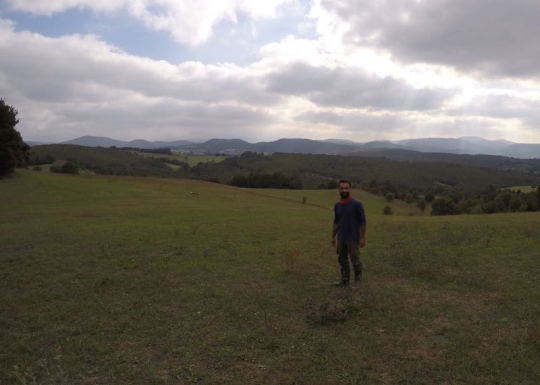
(Durukan stands over the rolling hills of the Anatolian Grasslands in Biga Turkey)
Ecology has become supremely efficient in closing this energy loop – and if what remains left is only the living matter designed to recycle energy and the dander called petroleum – the system that created and stored this energy in the first place is hungry to return itself back to an equilibrium As a systems thinkers – that is just common sense! Although, the described conduit of remediation now get much of the blame through the reductionist mindset. Food animals are now defined as a fundamental driver in climate change equal to human emissions? Well,with current confinement practices – this may be very true. Methane is anywhere from 25 – 85 times more potent an adulterant as compared to carbon dioxide, but the fundamental problem is the nature of the question. The animals are in fact an essential and key part of the solution. As author Judith Schwartz writes in “Cows save the Planet” – the disruptive forces of ruminants are actually the “crucible” of change in using soil to rectify climate change. Conventional methodology and associated reductionist theories to the environment, and our health, fail to evaluate how we’re all part of much bigger system that rely on being part of the living nutrient recycling program. As Allan & Durukan will continue to prove, there will be unlikely heroes in solving global problems through the bettering methods for how we feed ourselves.
ONEHEALTH FOR US ALL
Who the hell wants to be preached to regarding what they eat, or that of their family’s diet. Coming tooled with more & more knowledge of all these problems we’ve got going on and what the future will look like if we continue business as usual – I’ve had to learn how to be a much better dinner date. So, for all that bad, there’s actually incredible hope in rectifying these problems through proven and tested models that utilize the same solution to solve many problems. The best practices of circular agriculture can not only improve the health and welfare of the animal & farm worker, and source cleaner & healthier food but this same process can be our best remedy in healing a quickly warming and choking planet. That is a crazy paradigm shift in evaluating broader scale change that will correlate to many vested interests.
(the value of livestock has never looked so good as on working grasslands)
Whether it’s relating to practice, provenance or benefit – collectively, we’ve long since been food ignorant in the United States. Most times the truth is not what we want to hear, especially when dealing with something as intimate as the food we feed our families. But, the good news is that unlike any other time in history we can rectify a social wrong quickly. Through sustained awareness, education and proper truths that best service collective interests and not that of greed and hubris of a few groups who struggle to see the forest amongst the trees with their repeated claims that conventional production of cheap food has nothing to do with climate change, modern plagues like obesity, heart disease, cancers and that of general poor well-being which has inflicted US populous over the past 30 years – change is brewing. Our natural defense mechanism of common sense has been so desensitized we’ve simply lost perspective on the fundamental purpose of food. Without focus on well-being, cheap caloric energy is proving a killer to our health and that of our planet. We seeing signs of change, and the basis for that change is actually how we came to be in the first place! It’s an exciting time to be ruminant!
Political, moral, a business issue too; future food production on a shrinking planet has no place to hide!
A universal truth, consumers must know the facts of food. The impact of what reaches the dinner table is far greater than the resulting personal gain or satisfaction. Domestic US food production does not account for waste, environmental impact nor ecological footprint – that’s our actuality! We’ve flattened a circular process into a frozen rope. These additional costs from mining the soil without replenishing systems needed for self-sustaining nutrient cycling have created a never ending waste-stream and defined an intensifying need for persistent inputs. Despite wellness to consumer becoming of greater concern, a “true cost” of our linear food production is only just beginning to be realized with scarcer proximity to natural resources, and has yet to be incurred at the cash-register. With no scope nor expectation of re-payment of this tax, we’ve externalized these “true costs” of cheap food to lessen the vitality of the whole system.
You see, food production has great impact to planet, soil & water. If you believe this to be the case, and appreciate an evolution in US production is required – it‘s pretty straight forward – a bridge must be built. If we want to change this linear system so prevalent in the States, we must embrace with open arms current market leaders engaged in conventional agriculture to now partake in sustainable practice beneficial to their long-term sovereignty. As a call to action for my domestic brethren, we must adapt with empathy and diplomacy to accomplish greater impact. As serial entrepreneur and activist Gary Hirschberg explains “we must take a seat at the table if we want to be a voice of influence.”
When you break down all the factors, the Dutch have a compelling story of free-market success. Business working to help control their own destiny is a much better way to go through transition vs. a fight where you wait to see how hard the stick will strike. Numerous large companies in the Netherlands were proactive in servicing the changing desires of consumers for safe and nutritious food. Getting ahead of the regulatory curve by looking backwards to move forward, it was realized the authenticity in Dutch food production and provenance of farming became worthy of growth & advocacy. All the beneficial environmental and ecological impact was not just icing on the cake, but instead the core to a successful transition to circular.
An epiphany came during my fellowship to the Netherlands – with proof that not only is this the proper thing to do, as this planet is the only home we have to live, but it’s better business. ROI in converting and operating a circular approach has shrunk significantly in the last decade. System efficiencies, lower cost of waste stream and production inputs, economies of scale, better innovation & technology have all taken part in lowering the entry cost of producing circular. As increasing input costs compound with further requirements for more synthetics to produce the same volume of crop, it’s becoming hard to argue that the longevity and ongoing expense of circular is not a cost saver. Like the Dutch has demonstrated, if we employ this refined perspective as part of a true cost of food – taking into account a destiny of further regulation, increased expense and a change in consumer sentiment not be serviced – this puts new glimmers on leaders stepping-up to become accountable for our food actions.
We’ve done a nice job of justifying a lack of accountability for being grand-scale litter-bugs of linear perspective in the States. As the 800lbs Gorilla in global food production, reducing our externalized costs that currently accrue on ecology and the environment will be of great interest to many. Repackaged as opportunity for potential growth, mitigation to climate change, and that of risk mitigation against a public health concern & loss of market-share – we can embrace our mounting waste-streams and that of the imprint on planetary boundaries, through changing the short-cut practices putting us in harms way in the first place.
Aside from the financial driver discussion, we must start acting like responsible adults in managing this inherited dowery of earth’s fertility. That is just commonsense that seems to get strained with tainted short-horizon perspective and credulity. As part of estate planning, how is the health of the planet not of greatest concern in passing wealth & wellbeing to the next generation? Best yet, as a leader of any kind – how do you see yourself in other’s eyes? Are you looked up to as an empathetic individual attune to generation next; or a litter-bug on grand scale? To a man, as we still evaluate atwhatcost is cheap food paid. We deserve much more; leaders must step-up.
To drive broad & diverse consumer adoption of higher-quality food as preventative human and environmental healthcare, many required steps to evolve practice have already been drafted. Learning from close allies, we can gauge success in their tackling of same issue we now face on a shrinking footprint Stateside. From the financial bridge required to support circular production transition; to the appropriation of proper techniques and plans; to a distribution and value-ad frameworks that decommoditize food via technological backstory and provenance; to sharing, testing and monitoring best production practice in reducing the expense of waste in circular agricultural systems – it’s there. So, let’s stand-up like leaders, like parents our kids see us as – to address problems with haste and flip a method of sourcing sustenance corrosive in nature to one taking account for true cost.
BLUE CHIP INNOVATORS: the future lies in these hands
– – – For Turkey, and for us all.
It’s a bit frustrating; I’ve yet to see just stories defining hope and potential to this current situation in the Middle East. That may sound like an interesting perspective on the situation, but while in Turkey I witnessed a very different reality than being broadly portrayed to a global audience. I keep a keen eye looking for any storyline in the press defining leadership in this crisis, something I feel to be so essential in inspiring a generation next to learn from these repeatable mistakes, and cure a stronger foundation for future decisions. Thus far, in this real-time commingling coverage of the Middle East and Europe – media seems only to be proponents of despair. What’s even more asinine, at least from my point of view, the copycat reporting of keeping-up with the Turners is not vogue – it’s instead played out with every storyline on every news channel where volumes of noise and little sustenance are repeatedly dumped with little strategy and often less due diligence for purpose of throughput.
Enough already!
We need (some) narratives portraying alternative realities in the Middle East. An accurate reporting of stories where people are solving known problems and controlling their own destiny simply to act as a ray of hope for others. Throughout Turkey I witnessed these storylines of human spirit transcending the problem a hand, yet have not seen this presentation of that truth. I met folks of impeccable resolve and resilience that have revigorated my hope in the future, and counter much of this gluttonous noise spewed for nothing more than gross consumption of addictive fodder. Waiting to tell of these leaders in a retrospective after the crisis mitigates is just too late. Folks need accurate information in formulating an equitable opinion now.
I must reiterate from past essay – I know this exodus of refugees is an enormous humanitarian issue. But, those stories are being told by others; by all, potentially the same storyline ad nauseam. What remains untold in the short-term attention of the ratings-fueled press seems these essential stories of successful perseverance, chivalry and inspiration defining these areas of turmoil. One such story I’d like to share focuses on a very unexpected leader coming from a family who’ve already escaped the terrorism of the south, and despite what seems impossible odds to you and me, have begun to assimilate and integrate themselves into their new Turkish surroundings. Fundamentally, and potentially more relatable to us all – I believe this story presents a distinct example of where forced innovation can cast a long shadow when cultivated with a mindset of required diplomacy in a shared future on a shrinking planet.
Meet Ahmet and his cousin Ozan – pictured above
Two (very) young men who with near immediacy reinvigorated my enthusiasm for what tomorrow can bring when driven by the unbreakable spirit of motivated entrepreneurs. With a 2M populous, Bursa, Turkey sits due south of Istanbul on the Sea of Marmara. It has a bit of a feel of a poorer version of a Northern California city, but at an order of magnitude higher population density. What makes this city so unique is not just that it’s tucked throughout the foothills of the 8300 ft elevation Uludag mountain, but that those mountains are in fact – Mount Olympus. Little did I know when I arrived that the most interesting folklore I’d stumble upon in this original capital of the Ottoman empire would not be of Gods or civilizations thousands of years old, but instead that of two boys collectively barely two decades old.
(600 yr old Sycamore in INKAYA village – a first Ottoman village of Bursa)
During an open afternoon after my organized meetings were completed, I was huffing it up one of the hills behind my hotel on my way to a coffee shop with better than adequate WiFi. The tight and undulating streets of Bursa’s valley basin are a challenge to navigate never-mind when you begin to tackle the mountain itself. About a kilometer up, I stumbled across two young businessmen operating a pretty impressive logistics company. Wheeling a modified chariot (as pictured atop) down the incredibly hilly terrain of Mount Olympus, older and bigger cousin Ozan helmed a plastics collections vehicle while younger and charismatic front-of-the-house cousin Ahmet would visit the plastic refuse sites of each house and business along the street. I had witnessed grown-men doing something similar in Istanbul, but surely not with the same panache nor motivation. Taking time to make small-talk with local shop-owners, Ahmet worked that street like a master salesman. It was obvious he was well liked, as many along the way would smile, putting a hand on his little head and frail shoulders with touches of adoration, and respect. Intrigued, I had to stop and watch these craftsmen operate.
Retracing my steps just to keep an eye on and learn from these two little buggers, in the 15-20 minutes I watched, they’d only stopped working once to satisfy their curiosity as a small pack of street dogs and feral cats interacted. You should’ve seen the proficiency and efficiency for which these two did their job; no supervisor, no teacher, no boss – just work. Not too much older my own kids at home in Boston, as I watched them operate these tight residential streets filled with cars, scooters, buses and more – my first thought was disdain for how their parents could let this happen! Then, taking my tainted perspective out of their reality, I came to an overwhelming feeling of adulation for these two young entrepreneurs who’ve formulated a business of scrapping plastics as a unique form of forced innovation. Supremely focused on the task at hand, these two entrepreneurs put a smirk, and then a smile on my face unlike any other engagement during the entire fellowship experience in Turkey or the Netherlands. I was struck with an epiphany – what I’d first thought as unbelievable risk to have two unaccompanied kids who should be in school at that point of the day moving heavy loads down the middle of fast moving traffic was instead one of the finest examples of forced innovation I’ve ever seen. Any feeling of disbelief quickly morphed to- intrigue -to- fascination -to- inspiration. I don’t know the story of their parents, nor of Ahmet and Ozan current living situation, but I know they’re doing what they must to do more than survive, but to learn and establishing a future to thrive in this world. It was truly amazing!
As they pressed on I finally stopped retracing my steps at a point to insure they’d pass on my side of the street. Ahmet approached not asking for a flat-cash hand-out, he instead asked only for a few Turkish lira (exchange rate is about $1 = 3 lira) for bottled water for himself and his hardworking cousin. In broken English far better than any second language I speak, 9 year old Ahmet asked “two lira for Su (water); Ozan and me”. This experience was very different than what I’d recently encountered in the city of Izmir, a large coastal city of 5M south of Bursa. On the Aegean sea, Izmir has become the epicenter of Syrian refugees now receiving an estimated 6000 new inhabitants and/or transient population as day. I did see plenty of refugee turned entrepreneurs selling everything from street food, wet-naps, balloons and shoe cleaning services while in Turkey, but in Izmir I mostly witnessed folks in need, stuck not knowing what to do, or how to do it. While in Izmir I was afforded a unique learner experience. In effort to help a few of these families in need, I handed 20 lira to each, and became flocked upon until my wallet was empty of all 20 and 50 lira bills. Never feeling threatened, I was followed and harassed by men and woman for not giving equal amounts. A lesson learned for moving forward.
(Atatürk Monument to Turkish Independence welcomes refugees to Izmir)
But now, looking at this adorable face – this was different. With Ahmet, I was dealing with businessman. Truth be told, I was awestruck by these two guys. I’ve always been inspired by entrepreneurs who’ve turned a bad circumstance into a positive situation through successful business, but these two cats were taking it to a whole new level. It was an easy decision, how could I not become an investor in their triple-bottom line business dedicated to cleaning the streets, saving the environment and putting money in their family’s pockets through recycling plastics! As I emptied my wallet to pick up the cost of a few months of their collections duties – I thought to myself, a few decades from now I might be workings for these businessmen, so I better get in now!
First, and I’ll be clear – this is not what I want for my little ones. Nor probably what Ahmet and Ozan’s folks want for their kids. But, from a grander perspective – this is a much better reality than they knew in their hometown of Duma Syria, and a much different reality as being told with near singularity by western press. This may be an anomaly, or it could be more of a reality for many of the refugees who equally seek a future of freedom & opportunity. No matter, is presents an impeccable story of hope for a better tomorrow. To me, this also tells of different and more revealing Turkey which has been dealing with Syrian transplants for years. During that quick chat with Ahmet and Ozan (I’d later learn Ozan spoke no English when he came to check-on his younger and smaller cousin wrapped in a conversation with this American), I realized chivalry and bravery in this world now comes from a very different kind of hero than I would’ve ever expected, and that is uniquely exciting for us all.
(young entrepreneurs are teeming throughout Turkey’s evolving population)
From my experience in the region, the repetitive coverage by Western media of the same stories of despair, cruelty and coercion seem somewhat disingenuous; if nothing else too singular in the depiction of the truth. I heard one prominent Turkish business leader explain it to me as a ‘chumming of the waters’ for news ratings. This was further validated while staying in Istanbul and Ankara where the only English TV channels I had were CNN & BBC – which reported constantly on the crisis in Syria and throughout Europe. In each and every report I saw, both media hubs promoted their expertise as immersive or investigative journalists, but the longer I stayed in the region, and the more I saw, I realized that hiding behind that cloak was just not delivering an accurate depiction of the reality I was witnessing. Surely, that was a reality for many, and truly what I experienced may not be as sexy to report. That said, I began wondering where’s the objectivity, fairness and accuracy to future leaders like Ahmet and Ozan if the reporting of all despair was the only part of the story they heard, what influence would it have on the different storyline they lived?
My claim of the corruption in mainstream media’s presentation of the truth may drive analogies of potential RNC candidacy for president. In my defense, the clear differential is having no proclamation of media’s equitable treatment of me, but for others. And for that matter, nor can I claim any righteous stance of protecting the victims – as that type of baiting is the premise of my contention with how the story is being told. I would define my claim of unjust representation to fall somewhere in between. In this case – those fighting for themselves are not getting a fair rap, nor a stage to positively influence others.
As with anything – manipulating a storyline, or data, or for that matter biased scientific reporting (for all my food value compatriots) comes from tweaking the very question you seek to answer. At a top level, that question asked to be answered can be supported through many means of confirmation bias which, as in this case of the Syrian refugee crisis, reflects only a single perspective to support a desired point of view that may be more captivating news? Well, I think not, and the well earned bipartisan criticism of media becoming too business centric – looking for only advertising dollars through sex appeal or greater shock & awe seems further validated during these periods where there’s blood in the water.
Yes, never has an exodus of this proportion been streamed to all corners of the globe with such immediacy and transparency as seen today from the Middle East into Europe. With word that the gates have swung wide open, more than just Syrians have entered this Northern patronage. Once based on finding freedom and stability, the migration has turned quickly into others from many counties in search of greater opportunity & prosperity. Amongst some of the alternative stories selected to be covered by the press were again underpinned only by despair and turmoil. Families who’ve finally broken oppression in Syria to just begin an arduous multi-month journey of unknown destination and result, other reported stories have now surfaced of able-bodied men leveraging these families for their own gain. Claiming fictitious familial relationships with these children and elderly to expedite their positions in the queue to cross a next border, these candy-asses steal the press from true leaders like Ahmet and Ozan. When afforded expedited access through checkpoints, the process is repeated where these men use a next family or person in need to ‘jump’ closer to the front of each and every line. In the face of mass tyranny, as explained through media’s many human interest stories focused on those in dire need and peril, the alternative storylines chosen to be reported are now of cowardice & selfishness.
I believe differently, and as Ahmet and Ozan present to me and hopefully you – our desire to believe in inspirational leaders no matter their age, to believe in those who’ve overcome what seem insurmountable odds, is as a basic a human need as food, water, and love.
(a teenage entrepreneur works hard in keeping us tourists looking good)
The truth is, many do need our help. But, what I find comforting and you should feel reassuring is that there are future leaders like Ahmet and Ozan living through situations likes these. So, no matter how far away you feel from this situation, or if you’ve politically alienated yourself from this or another situation similar on our southern borders – when you’re there and see it first-hand you realize these folks are not that much different than you and me. And surely no different than my ancestors who a century back fought similar battles in seeking greater stability and opportunity for the future of our bloodline. We all have the same desires, hopes and dreams and with that understanding and appreciation perspectives will change. We realize that no matter what media wants to sell to us, we live in a shared tomorrow, and we better start evaluating it as such.
– by Dr. Bastiaan Meerburg – Wageningen UR – original content
Our human population is growing and expected to reach 9.7 billion inhabitants in 2050. All of them need sufficient food of good quality. This puzzles me. How are we able to feed all those people with only one earth that we have available? How can we prevent famine, but also prevent the loss of natural resources at the same time? I think today those questions matter a lot. What would be the best? Agricultural intensification on the agricultural acreage that already is present? Which means going for high yields while at the same time accepting that the natural value of this acreage is limited? Or should we lower the output on the current agricultural acreage, creating more natural value there, but on the same time accept that more tropical forest is converted into agricultural land?
Think global, act local
In Europe, in 1988 a set aside scheme was introduced by the European Union to help reduce the large and costly surpluses produced in Europe under the guaranteed price system of the Common Agricultural Policy (CAP) with as one of the main goals to deliver a number of environmental benefits to damaged agricultural ecosystems. This scheme was abolished in 2008, because of the soaring cereal prices. Earlier, in the United States of America, a more or less similar kind of scheme (not used since the late 1970s) existed.
Currently, greening of the CAP is one of the main goals of the European Union. Farmers must designate a percentage of their acreage (7% of their arable land) as ecological focus areas (acreage that is fallow or contains landscape features, buffer strips or forest). Although this seems fairly reasonable, in fact a significant policy choice is made here, and I wonder whether this has been taken into account by politicians.
Many studies mention positive effects of set aside land on the local biodiversity (e.g. Henderson and others 2000; Herzon and others 2011; Kovács-Hostyánszki and others 2011) and cropland with restored ecosystem services is often seen as the solution serving a broad portfolio of ecosystem services (Foley and others 2005), see Figure 1.
Figure 1: Conceptual framework for comparing land use and trade-offs of ecosystem services. The provisioning of multiple ecosystem services under different land-use regimes can be illustrated with these simple “flower” diagrams, in which the condition of each ecosystem service is indicated along each axis (Foley and others 2005).
Of course, this can be true at the local scale, but what does set aside land mean for the global biodiversity? To my knowledge this relation has not yet properly been investigated. We however know that the most important form of land conversion is an expansion of crop and pastoral land in natural ecosystems (Lambin and Meyfroidt 2011). During the 1980–2000 period, more than half of the new agricultural land across the tropics came at the expense of intact forests, and another 28% came from disturbed forests (Gibbs and others 2010). Together, croplands and pastures have become one of the largest terrestrial biomes on the planet, rivaling forest cover in extent and occupying ∼40% of the land surface. In 2012, about 4.92 billion ha globally was used for agriculture, of which about 70% was used for livestock production, mainly for pasture and production of feed crops (FAOSTAT). Global land-use for crop production is about 1.56 billion ha. Assuming 9.7 billion people in 2050, then about 0.16 ha of cropland is available per person.
In the past, changing land-use practices have enabled world grain harvest to more than triple in the past five decades, now exceeding 2.7 billion tons per year (Figure 2).
Figure 2: Development of the total global cereal production 1961-2013. Source: FAOSTAT.
Much of this increase can be attributed to a ~10% increase in world cropland area (FAOSTAT), but most of these production gains resulted from the use of “Green Revolution” technologies, including high-yielding cultivars, application of chemical fertilizers and pesticides, and further mechanization and irrigation. Although it can be expected that introduction of new technologies may be capable to keep up the pace with the reducing availability of land because of the introduction of set a side schemes, it means that additional efforts should be made to introduce technologies that one hand increase the productivity while at the same time prevent negative side effects such as soil erosion. And besides increasing production, a better focus on prevention of pre- and postharvest losses might also prove useful to provide the global population with sufficient food. In India, for example, it has been reported that 6-9% of the paddy rice in storage is consumed by rodents. If worldwide post-harvest losses by rodents were reduced by 5%, about 280 million undernourished people could additionally benefit (Meerburg and others 2009). So also there, substantial gains can be made.
But now let’s focus again on agricultural acreage and biodiversity. Displacement of land use from a place occurs when there is a migration of activities to another place, therefore causing land change in the other locality is called leakage (Lambin and Meyfroidt 2011). The adoption of a set aside policy in the EU might trigger strong cross-border leakages and increase pressure on land use elsewhere. There is strong evidence of such cross-border leakages: between 1990 and 2004, developed countries that enacted conservation set aside policies increased their cereal imports per capita by 42.2% compared with an average 3.5% increase for countries that did not enact such policies (Rudel and others 2009). Because of such increased demands, the need to increase agricultural production in countries with many natural ecosystems may lead to degradation of the latter, with potentially huge effects on biodiversity.
But what to do? The set aside policy of the European Union can thus be effective for local biodiversity, but might cause new and more severe problems elsewhere. Generally, I guess that politicians have the general goal to do good in mind, but they cannot oversee the consequences of their actions thus causing more trouble. Or: what happens behind the horizon, stays behind the horizon.
Only in a minority of cases (as happened with the production of biofuels, when a lot of farmers suddenly switched from the production of food and feedstuffs to biofuels and global food prices soared sky-high) a defined policy is changed again. But I wonder whether a gradual change of land use elsewhere might trigger such action, as food and feed prices will be less affected in this particular case. And consequently: the effect on biodiversity may be large. This leads to a question that seems awkward: What is more important: presence of a farm bird in Holland or a monkey in the rain forest in Brazil? Personally, I don’t know.
This trade-off between local and global biodiversity is not the only challenge that should be better looked into by scientists in the near future. Changes in biodiversity and use of agricultural land can be the result of many changes in atmospheric carbon dioxide, climate, vegetation and the known sensitivity of such systems to these changes (Sala and others 2000). This makes life very complex, but in order to make good policy decisions it is essential that scientists provide policy makers and politicians with accurate information. Only by doing so we may finally come to a situation where we truly think global and act local and look behind our own horizon.
Literature:
Foley JA, DeFries R, Asner GP, Barford C, Bonan G, Carpenter SR, Chapin FS, Coe MT, Daily GC, Gibbs HK et al. . 2005. Global Consequences of Land Use. Science 309(5734):570-574.
Gibbs HK, Ruesch AS, Achard F, Clayton MK, Holmgren P, Ramankutty N, Foley JA. 2010. Tropical forests were the primary sources of new agricultural land in the 1980s and 1990s. Proceedings of the National Academy of Sciences 107(38):16732-16737.
Henderson IG, Vickery JA, Fuller RJ. 2000. Summer bird abundance and distribution on set-aside fields on intensive arable farms in England. Ecography 23(1):50-59.
Herzon I, Ekroos J, Rintala J, Tiainen J, Seimola T, Vepsäläinen V. 2011. Importance of set-aside for breeding birds of open farmland in Finland. Agriculture, Ecosystems & Environment 143(1):3-7.
Kovács-Hostyánszki A, Kőrösi Á, Orci KM, Batáry P, Báldi A. 2011. Set-aside promotes insect and plant diversity in a Central European country. Agriculture, Ecosystems & Environment 141(3–4):296-301.
Lambin EF, Meyfroidt P. 2011. Global land use change, economic globalization, and the looming land scarcity. Proceedings of the National Academy of Sciences 108(9):3465-3472.
Meerburg BG, Singleton GR, Leirs H. 2009. The Year of the Rat ends—time to fight hunger! Pest Management Science 65(4):351-352.
Rudel TK, Schneider L, Uriarte M, Turner BL, DeFries R, Lawrence D, Geoghegan J, Hecht S, Ickowitz A, Lambin EF et al. . 2009. Agricultural intensification and changes in cultivated areas, 1970–2005. Proceedings of the National Academy of Sciences 106(49):20675-20680.
Sala OE, Stuart Chapin F, III, Armesto JJ, Berlow E, Bloomfield J, Dirzo R, Huber-Sanwald E, Huenneke LF, Jackson RB et al. . 2000. Global Biodiversity Scenarios for the Year 2100. Science 287(5459):1770-1774.
While in the Netherlands I learned of Henk Ovink; a Dutch national who at the age of 47 had already established a global reputation as the man-for-water. During fellowship travel & meetings, Henk’s work throughout the Netherlands and that of the United States, came to light often. Most noticeably, his captaining the launch and orchestration of the epic Superstorm Sandy rebuild. So impressive was his knowledge and insightful plan – United States Secretary of Housing and Urban Development, Shaun Donovan, expedited Henk’s ownership of this supremely high-profile clean-up & rebuild effort through a creative trade relationship engaging Henk as special water envoy to the US. At this point in time, when the United States of America is making-up new titles for you – you’ve got some good things cooking.
Entering my last week in the Netherlands, after hearing of these accolades of a real-life Aquaman tackling significant problems – I had to reach out to the Grande Dames of Eisenhower Netherlands and ask for help in setting-up a meeting with this guy. And they did, quickly opening the doors for which Lia from APEP again executed. We had a meeting arranged that next Monday, a holiday in the Haag.
HENK OVINK – Special Water envoy to US
Water has not been a policy issue in the U.S. That’s because you’re mostly all above sea level. But what if the sea level changes? H.OVINK
To establish some scope as to why I was so intrigued to meet with Henk – water is agriculture; especially all future agriculture. It’s vitally important to learn how to better maintain reservoirs increasingly stressed to serious jeopardy; how to properly store water in the sponge of topsoil; how not to contaminate our vital building block which literally is our essence; and how to deal with risks of drought, flood or destructive forces of sea or fresh water-surgence to current food production. With 70% of global fresh-water currently being allocated to agricultural irrigation, and known expansion plans of demand and imprint – as we begin to see conventional production pressing closer to an impending ceiling, water seems destined to be the instigator of change in food. A modern stab at a food-plan that tackles water issues would prevent further risks of failure like drought in California, or that of the looming possibility of a 2nd dust-bowl when the Ogallala aquifer that stitches together overwatered production in our breadbasket reaches point of no return. Often defined as next oil, I think water is a hell of a lot more important than that; without access to ample water to raise food from plant nor animal- we’ll fail through our food, thanks to water.
Henk and I caught-up at a outdoor cafe in the Haag. He’s a smooth cat, with big plans. I enjoyed our conversation greatly; his work ethic was as apparent as his intent. The results he’s demonstrated with engaging public and private sector is inspirational. He explained that without strong dykes and buffering of canals – 60% of the Netherlands would be underwater. Basically, the entire process the Dutch have adopted and built innovation around is – instead of fighting water, embrace it with open arms. This stems from a same vein that looks for innovation in water, including agricultural models that originated wind-mills, and channels to buffer floods through properly storing water for future irrigation. Henk’s model for SuperStorm Sandy pulled together best innovations and technologies in a creative manner. Supremely smart planning followed suit, and his use of an innovation economy has and will go a long way in affording better resistance during times of stress or disaster that will be proven not only immediately in Long Island sound, but around the US and globe as much of these best practices are being shared, and scaled for global consumption.
‘How to think like a Dutchman in a post Sandy-World’ – NYTimes:
Dutch skill at water management goes back to the dikes, dams and windmills with which they reclaimed much of their land from the seas and rivers starting in the Middle Ages. In the 1950s, they constructed the Delta Works, a revolutionary series of storm-surge barriers along the North Sea coast. But thinking has evolved since then. With the increasing threat caused by climate change, Dutch engineers have developed strategies that go beyond simply trying to keep water out. The city of Rotterdam, for instance, is building floating houses and office buildings and digging craters in downtown plazas that will be basketball courts most of the year but will fill up with runoff during high-water periods, taking the strain off the surrounding streets.
Henk Ovink employed an innovation economy to deliver Rebuild By Design, an RFP that received hundreds of original bids as possible allocations for Super Storm Sandy relief money. Drawing from the best thought-leaders and planners of resilience from around world, coastal New York & New Jersey gained the eye and resulting submissions of some of the most talented folks in the world through what could be best defined as a successful idea-crowd-funding initiative. Henk defined a plan, he got the best, and they delivered in droves…
Most recently, Henk and the Dutch government began a plan to foster greater water ingenuity. One of the booklets provided at our meeting,Water Innovations in the Netherlands presents 35 different innovations dealing with a diverse way to best utilize or prevent water catastrophe.
In March 2015, Ministers Schultz van Haegen (Infrastructure and the Environment), Ploumen (Foreign Trade and Development Cooperation) and Kamp (Economic Affairs) appointed Henk Ovink (47) as the first Special Envoy for International Water Affairs for the Kingdom of the Netherlands. In his capacity as thematic ambassador, the Special Envoy for International Water Affairs reinforces Dutch ambitions in the water domain; he contributes to boosting the international market position of Dutch know-how and expertise.
Worldwide, water is a connecting issue. With its integrated approach to water shortages, water safety, water quality, logistics and transport, the Netherlands make the difference across the globe. We are leaders in the field, which is welcome, but that also obliges us to continue to invest and innovate, in the Netherlands and abroad. Our Dutch know-how and expertise are unique. I see plenty of opportunities to utilize this knowledge even better at the international level.”
Ambassador:
The key task of the Special Envoy for International Water Affairs involves economic diplomacy: as the ambassador for the Dutch water sector, he is responsible for maintaining good relations with foreign governments, knowledge institutions, umbrella organizations, coordinating and representative bodies, the business community and civil society organizations. He establishes connections with the other relevant top sectors (energy, agriculture, the creative industry). He collaborates closely with Dutch Embassies, Consulates and Permanent Representatives. He also maintains direct contact with bilateral and multilateral actors such as the World Bank, the United Nations, the OECD and the EU. He’s representative of the Ministers at international water meetings.
Henk previously held the position of Deputy Director-General of Spatial Planning and Water Affairs at the Ministry of Infrastructure and the Environment, and Director of National Spatial Development. Mr. Ovink currently serves as a senior advisor to the American Federal Government and the former Hurricane Sandy Rebuilding Taskforce instituted by President Obama. For the reconstruction of the New York and New Jersey region, he developed and lead the ‘Rebuild by Design’ contest, which CNN designated as one of the most innovative ideas of 2013. Mr. Ovink has a long record of service in the business community, education and the government in the fields of spatial planning, water management and culture. Among other activities, he has served as Curator to the 5th International Architecture Bienniale Rotterdam, he sits on the International Advisory Board of the city of Rotterdam, he teaches at Harvard GSD and he advises the Rockefeller Foundation regarding their approach to resilience and water safety.
No water, no life. No blue, no green. S. EARLE
Getting too much water, or too little, is a reality of modern agriculture. It’s the elixir and the expeditor! The contamination of runoff & depleting process of conventional practice is stressing systems once assumed to have ample supply. The circular system gives back, and the more waste you can reduce – the less input and expenditures are incurred the following year – this holds very true for water. Circular also reduces the risk of synthetic toxins and steroids reaching the water system through abstinence; at least that’s what Henk tells me he and his buds at the Hall of Justice are working on.
A ray of hope casts a long shadow: Turkey – first essay
——————–
Since arriving in Turkey I’ve had a full schedule of activities. From meetings, farm-visits, conferences, events and meals – I’ve had a full docket of learning about domestic agriculture, food system and water utilization from many in the know. Now, leveraging a first day off after 17 on the move – with no set plans aside from a bit of shopping and sightseeing – I thought I’d share some of the sentiment I’ve witnessed that may not mesh with the media’s portrayal as you’ve seen Stateside and in Europe. There is without a doubt an epic humanitarian crisis & turmoil boiling over in the Middle East. If you’re watching the news, it does appear the world is burning and accelerants seem incited by further coverage of daily activities in the origin of where civilization began.
Specifically in Turkey, there’s a feeling of concern for their southern neighbors, but though the awareness of Syrian migration is new to the Western world and the North, Turkey has been dealing with these issues for years. With already 2 million new Syrian refugees in Turkey over the past 6 months, I’ve been told that if you re-draw your parameters back a few years – the actual number of Syrians in Turkey is twice that. Though related, without a doubt the most pressing concern of Turkey is that of its political future set to determined by the populous in only 10 days. No matter political affiliation to current AK leadership, Socialist party, Nationalist or Kurdish – each has a vision for a prosperous and safe future. Just as what we experience in the States, that patronage to what success will actually look like is where points-of-view drastically differ.
To me, the most tell-tale fact for the future of Turkey lies within the expected 80% turnout for that forthcoming Parliamentary election. No matter the current state of political separation, terror concern, refugee relation, or alignment with Russia, the US or the EU – the engagement of the populous presents an exciting future for Turkey no matter the results of this election. It presents Turkish citizens that greatly care and will engage in defining their own destiny. More importantly, underpinning that belief clarifies the situation even further as it represents a general consensus that implementing democratic and diplomatic strategies over military force will govern the future of their country. That’s a big win, and worthy of standing for. As the literal & figurative bridge to so many cultures, religions and beliefs – a successful Turkey represents an inevitable future world from which we must all learn.
Most of the questions I’ve fielded thus far from friends and peers have centralized around the current state of Turkey and the region. With the essay series atWhatCost I detailed findings of a fellowships program in the Netherlands through stories of key meetings while researching circular agriculture, nutrient security and water access. I plan to do something similar relating to my studies in Turkey at a later date, but I thought it worth a few short essays describing what I’ve witnessed first hand while trying to immerse myself into Turkish culture equally as a traveler and analyst.
To be forthright, the Eisenhower program affords unique access, resources and logistics to maximize time. From diverse and proper meetings, to unlimited assistance from onsite handlers, program manager and interpreters – it would be disingenuous to say that the efficiencies in the orchestrated program were not useful, or were all my own. To that, traveling on your own in a foreign land with no common language spoken outside populations densities, where I spend more than half my time, has been very informative for many reasons. First, I do stand-out physically in Turkey. In fact, a bit like a sore thumb. I really don’t blend in, nor do I try to pretend. I do work hard not to present myself as an American tourist nor businessman, but I’m sure that’s how I may appear to many. I task myself to turn of the GPS on the phone and spend time getting lost in local communities. To eat in smaller cities centers, and sharing Turkish Chai & coffee with locals has provided some of my most unique conversations. Some of those discussions were based nearly completely on hand gestures, broken English (or even more-broken Turkish from me), or that of drawn pictures, and sometimes Google as a translator.
A few times in these impromptu conversations I’ve noticed myself laying on the charm especially thick when there has been no understanding of each other’s language and a general lack of comprehension in the conversation. I feel a bit like I’ve reverted back to my school-aged years when I’d lack understanding of the subject matter and try to talk my way out of a paper bag. Funny enough, one strategy that seems hard-wired into me and also shared by many others Americans is a repetitive use of a descriptive English word by only altering twang, undulation, cadence or volume. Somehow, we think that chipping away with that same word, obviously very different in Turkish translation, will eventually get us to an understanding?! Thus far in these conversations we’ve always found a way to get through it all on the same page. At least I believe that to be the case. But, I’ll keep my eye and ears open to the stories of a 6’4” American tourist who speaks passionately about food through only his hands!
Clearly, all of my pre-arranged meetings for the fellowship program have been in English or through an interpreter. There is no question of wasting anyone’s time trying to communicate without a common understanding. What I reference above are the after work-hour serendipitous meetings that have provided further nuance to my understanding of the state of Turkey that will most likely not be captured in a boardroom or a Ministry office.
Focusing on food, something unilaterally intimate to most, I’ve been provided opportunity to gain unique access to many stories and storytellers who’ve shared with me the current situations of safety, freedoms, religion and humanity in Turkey. Despite my shortcomings to effectively speak Turkish, between these intriguing multiple senses conversations with the locals, and others through my translator, or those with the many multilingual Turks who speak English very well – I’ve been able to thus far to gain a different sentiment of Turkey and relations within the Middle East than that are not being well defined by Western or Northern media. Maybe it’s the general nature of breaking bread, but these stories present a different future for Turkey. One not yet expressed, but what I believe to be a better reflection of what’s truly the state of this complex union.
Without a set agenda or deadline, over the next few weeks I’ll sporadically share some of these stories. It must be our goal to gain further insight. To dig deeper, and to learn more of why and not just how. History is full of examples where continuing to sweep the problem of today under the rug for tomorrow only further promotes additional bias and later incites more enemies. It’ll again prove to get us nowhere fast is we don’t tackle the situation head-on through diplomacy before might! We’ve helped build this tinderbox, and now it’s our responsibility to help defuse the situation domestically with proper knowledge and better appreciation of the situation, and work in conjunction with key allies with far greater local knowledge than our own. This evolution in mindset seems a required next step toward a more empathetic and tactful future shared on shrinking planet of increasingly divergent views.